
Colour analysis is a professional consultation that identifies which colours best complement your natural skin tone, hair, and eyes—helping you look healthier, more vibrant, and more put-together. In Singapore, colour analysis sessions typically cost between $150-$500, take 1.5-3 hours, and result in a personalised colour palette you can use for clothing, makeup, and accessories. The most accurate results for Singapore's diverse population—Chinese, Malay, Indian, and Eurasian—come from systems developed specifically for the full range of Asian undertones, rather than adapted Western or Korean methodologies.
This guide covers everything Singapore residents need to know: how colour analysis works, what the different systems mean, specific considerations for different ethnic backgrounds, what to expect during a session, and how to choose the right analyst for your needs.
What is Colour Analysis and Why Does It Matter?
Colour analysis (also called personal colour analysis or seasonal colour analysis) is the process of determining which colours naturally harmonise with your unique colouring—your skin tone, hair colour, and eye colour.
The right colours make you look:
- Healthier — Your skin appears more even and radiant
- More vibrant — Your features "pop" rather than fade
- More present — People notice you, not just your outfit
- Younger — The right colours minimise dark circles and imperfections
The wrong colours do the opposite. They can make you look tired, washed out, or older than you are—even when you're well-rested and the outfit itself is beautiful.
Why most women get it wrong
Most of us choose colours based on trends, what's available in stores, or vague advice like "wear black—it's slimming." But colour isn't one-size-fits-all. What makes your colleague glow might make you look sallow.
"Black doesn't universally flatter everyone. Some people look yellow or pale in black because of the high contrast against their skin. The key isn't just wearing dark colours—it's wearing YOUR right colours."
Once you know your colours, everything changes. Shopping becomes easier. Your wardrobe becomes more cohesive. And you finally understand why some outfits just "work" while others don't.
How Does Colour Analysis Actually Work?
The colour analysis process centres on a technique called colour draping—holding different coloured fabrics near your face and observing how each affects your appearance.
The draping process
A trained colour analyst will drape you in dozens of different coloured fabrics, one at a time, while observing your face in natural light. They're looking for:
- Harmony — Does the colour complement your natural colouring?
- Brightness — Do your eyes appear more vibrant or duller?
- Skin clarity — Does your complexion look clear or does it emphasise imperfections?
- Overall effect — Does the colour make you look healthy and present, or does it overpower you?
Some colours will make your features come alive. Others will drain your face of colour or create harsh contrasts. The difference is often dramatic and immediate.
What determines your best colours
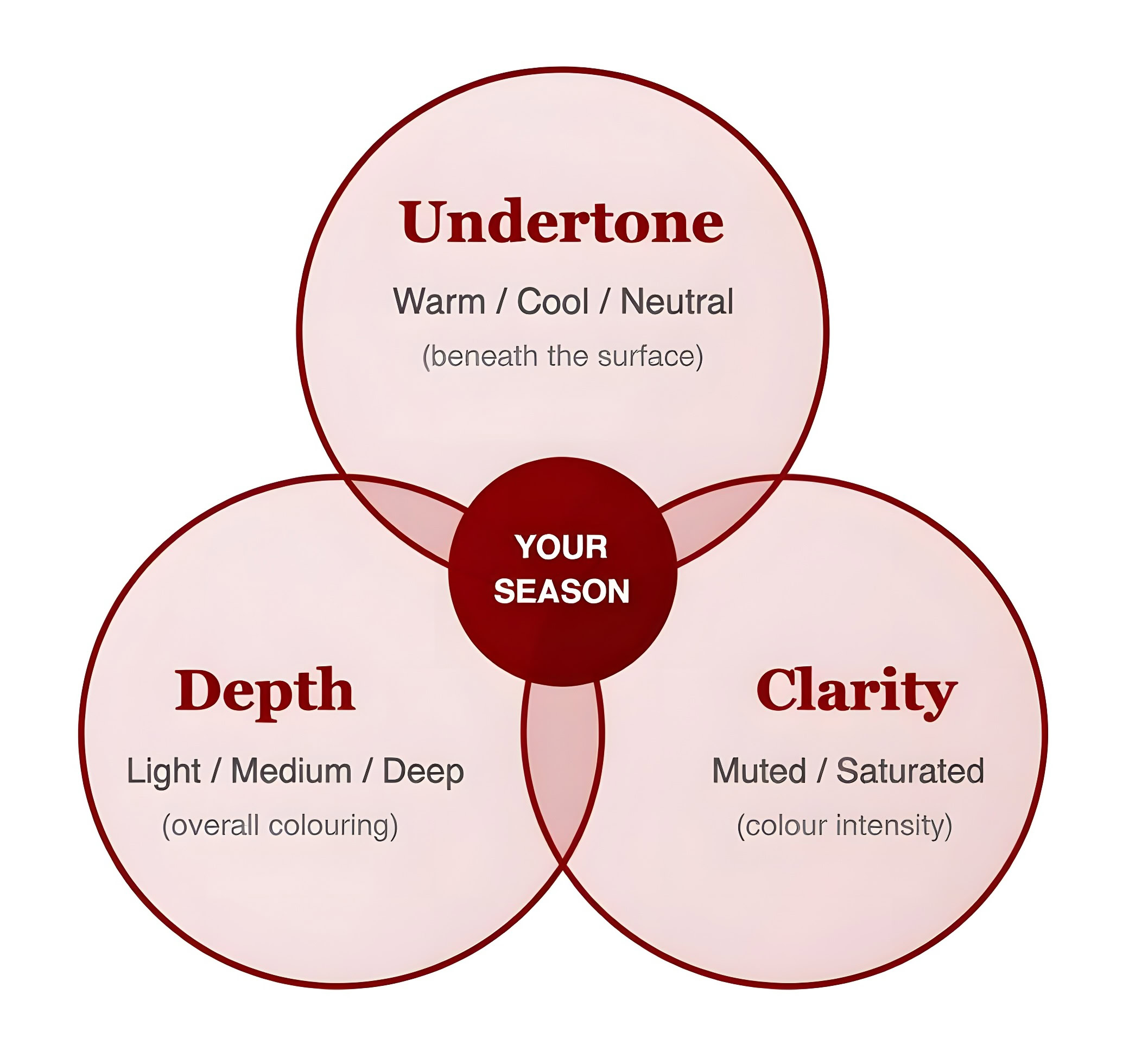
Your ideal colour palette is determined by three factors:
- Undertone — Whether your skin has warm (yellow/golden) or cool (pink/blue) undertones, or neutral (a balance of both)
- Depth — How light or dark your overall colouring is
- Clarity — Whether you look better in muted or saturated colours
These three factors combine to place you within a colour "season" or category—more on that below.
The 4-Season vs 12-Season Colour System: What's the Difference?
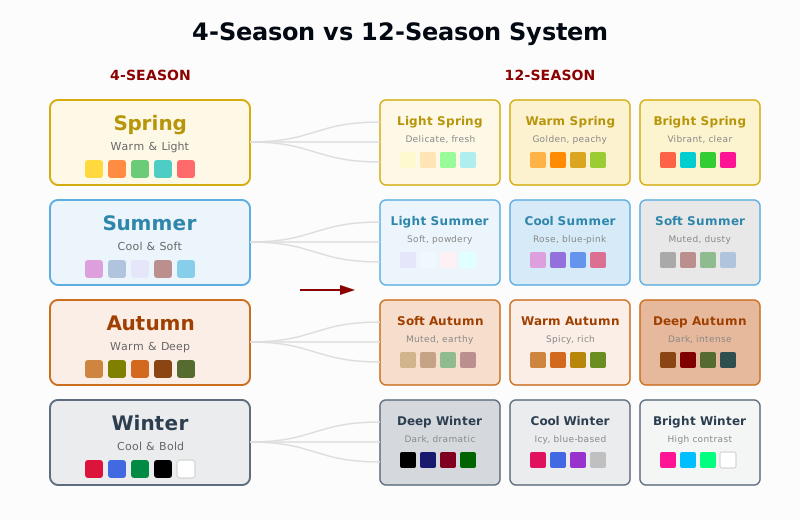
You've probably heard of the four colour seasons: Spring, Summer, Autumn, and Winter. This original system, developed in the 1980s, categorises people into one of four palettes based on their colouring.
The 4-season system
| Season | Undertone | Characteristics | Best Colours |
|---|---|---|---|
| Spring | Warm | Light, clear, warm colouring | Peach, coral, warm greens, golden yellows |
| Summer | Cool | Light, soft, muted colouring | Soft pinks, lavender, powder blue, dusty rose |
| Autumn | Warm | Deep, muted, warm colouring | Rust, olive, burnt orange, chocolate brown |
| Winter | Cool | Deep, clear, cool colouring | True red, royal blue, emerald, black, white |
The problem for Asian skin tones
The 4-season system was developed primarily for Western skin tones. It doesn't account for the nuances found in Asian complexions—the specific undertones, the way Asian skin interacts with certain colours, or the range of depth within Asian colouring.
The 12-season system
The 12-season system breaks each of the four seasons into three sub-categories, providing much more nuanced results:
- Spring: Light Spring, Warm Spring, Bright Spring
- Summer: Light Summer, Cool Summer, Soft Summer
- Autumn: Soft Autumn, Warm Autumn, Deep Autumn
- Winter: Deep Winter, Cool Winter, Bright Winter
This system recognises that someone might be "mostly Autumn" but need brighter colours than the typical Autumn palette—making them a "Bright Spring" instead.
"We use a 12-seasonal system because Asian skin tones don't fit neatly into just four categories. Someone might assume they're a 'Summer' when they're actually a 'Cool Winter'—and that difference completely changes which colours will make them glow."
Why Singapore Needs Its Own Approach to Colour Analysis
Here's what most colour analysis content won't tell you: skin tone (how light or dark you are) and undertone (the colour beneath your skin) are completely independent. This single misconception leads to the most common colour analysis mistakes in Singapore.
A fair-skinned person can have warm undertones. A dark-skinned person can have cool undertones. Your undertone is invisible to the naked eye—it can only be determined through professional draping, not by looking in a mirror or checking your vein colour.
The Science
The science is clear: skin undertone and skin depth are determined by fundamentally different biological mechanisms. Depth depends primarily on total melanin quantity; undertone depends on the ratio of melanin types (eumelanin vs pheomelanin) plus hemoglobin and carotenoid visibility. In the CIE L*a*b* colour system used in dermatological research, lightness (L*), red-green (a*), and yellow-blue (b*) are three independent dimensions (Ly et al., 2020).
One important qualification: in very deep skin tones, high melanin concentration can visually mask some undertone signals—hemoglobin and carotenoid contributions become harder to detect beneath dense pigmentation. The undertone still exists biologically; it's simply more challenging to observe. This is precisely why:
- Professional draping matters more than mirror self-assessment
- Analysts experienced with diverse skin depths deliver more accurate results
- The "dark skin = warm undertones" myth persists despite being scientifically false
Why Singapore is unique
Singapore's population includes Chinese, Malay, Indian, Eurasian, and countless mixed-heritage individuals—each with distinct skin characteristics that don't fit neatly into any single colour analysis system developed elsewhere.
Singaporean Chinese Skin Tones
While Singaporean Chinese share some characteristics with Korean and other East Asian skin, there are notable differences:
- Singaporean Chinese skin often displays more variance in undertone than Korean skin
- The tropical climate affects how skin presents—more tanning, different oil production, and sun exposure patterns
- Some Singaporean Chinese have olive undertones (a mix of warm and cool with a greenish-grey cast) rather than purely warm or cool
The Korean colour analysis trend on social media has popularised the concept beautifully, but Korean systems were calibrated specifically for Korean complexions. Research using objective colorimeter measurements confirms that Korean women show measurably higher yellowness (b* value) in skin colour compared to other East Asians—with Korean women averaging b* 20.56 compared to 19.28 for Cantonese Chinese women, a statistically significant difference (Cho et al., 2015).
A Singaporean Chinese woman might be analysed as "Warm Spring" using Korean methods but actually glow in "Cool Winter" colours—the difference is transformative.
Common Misconception
"I have yellowish skin, so I must have warm undertones."
Reality: Surface yellow is an overtone (what you see). Undertone is beneath the surface. Many Chinese Singaporeans with visibly golden skin actually have cool or neutral undertones. Only draping reveals the truth.
Malay Skin Tones
In Malaysia and Singapore, terms like "kuning langsat" (yellowish, like the langsat fruit) and "sawo matang" (brown like the sapodilla fruit) describe skin tones with more surface warmth. But here's the critical insight: surface colour doesn't determine undertone.
A Malaysian colour analyst recently explained this perfectly: "Just because we have brown skin doesn't automatically mean we have warm undertones. People can't see undertones—they can only be determined through fabric draping."
Many Malay women assume they need warm makeup (brown eyeshadow, peachy blush, orange lipstick) because of their visible skin colour. Some discover through professional analysis that pink lipstick, rose blush, and grey eyeshadow actually look far more natural on them—because they have cool undertones beneath that golden surface.
Common Misconception
"Tan skin means I should wear earthy, warm colours."
Reality: Malay skin can be warm, cool, or neutral regardless of depth. Some of the most striking transformations we see are Malay clients who've worn brown their whole lives discovering they actually glow in berry tones and cool emerald.
Indian Skin Tones
Indian skin presents perhaps the widest range of any ethnic group in Singapore—from the very fair complexions common in Kashmir, Punjab, and North-East India to the deep espresso tones of Tamil Nadu and Kerala.
The most damaging myth about Indian skin
Many assume darker Indian skin automatically has warm undertones. This is demonstrably false. Research confirms that undertone and skin depth are biologically independent variables (Ly et al., 2020). Supermodel Alek Wek, with extremely dark skin, has cool undertones. Meanwhile, a fair-skinned North Indian woman might have warm undertones.
Understanding the range
| Indian Skin Depth | Possible Undertones | Notes |
|---|---|---|
| Fair (Kashmir, Punjab, some North-East) | Cool, warm, OR neutral | Often mistakenly assumed to be cool |
| Medium/Wheatish (Most common across India) | Frequently neutral, but can be warm or cool | Neutral undertones are very common here |
| Dusky/Olive (Common across regions) | Often neutral or cool with olive overtone | Olive adds complexity—needs careful analysis |
| Deep/Dark (Tamil Nadu, Kerala, parts of Karnataka) | Cool, warm, OR neutral | Most commonly misdiagnosed as warm |
The gold jewellery assumption
The traditional advice that Indians should wear gold jewellery isn't always correct. Those with cool undertones often look more polished and radiant in silver or white gold, even with deep brown skin. The "Indians suit gold" rule has led many women to wear the wrong metal for decades.
Regional considerations
- North Indian skin often has pink or neutral undertones beneath fair to medium depths
- South Indian skin can have either warm golden undertones OR cool blue-red undertones beneath deeper complexions
- East Indian skin (Bengali, Odia) frequently shows olive characteristics
- West Indian skin (Gujarati, Maharashtrian) spans the full spectrum
The key takeaway: there is no single "Indian skin tone." Professional analysis is essential because assumptions based on region or depth are unreliable.
Eurasian and Mixed Heritage Skin Tones
Mixed heritage individuals often have the most complex colour profiles—undertones that blend characteristics from different ethnic backgrounds in unique ways.
Professional analysis is particularly valuable for Eurasian clients because:
- Home tests (vein colour, gold vs silver jewellery) often give contradictory or inconclusive results
- Online quizzes cannot account for the specific combinations present
- The interaction of different genetic colour influences creates truly unique palettes that don't fit standard categories
Many Eurasians find they sit between seasons—perhaps a "Soft Summer" with some Autumn characteristics, or a "Deep Winter" who can borrow from "Deep Autumn." The 12-season system's flexibility becomes essential here.
The Contrast Factor
Beyond undertone, skin contrast matters significantly for everyone regardless of ethnicity. Contrast refers to the difference in value (light/dark) between your skin, hair, and eyes.
- High contrast: Strong difference between features (e.g., fair skin with jet-black hair and dark eyes)
- Low contrast: Features blend together in similar values (e.g., medium skin with soft brown hair and hazel eyes)
A fair Chinese woman with jet-black hair needs different colour intensity than a fair Chinese woman with softer brown hair—even if they share the same undertone. High-contrast individuals can wear bolder colours; low-contrast individuals often look more harmonious in softer tones.
This is why draping with actual fabrics, in proper lighting, by a trained analyst remains the gold standard. No online quiz or mirror test can assess contrast, undertone, and depth simultaneously the way professional analysis can.
Why Korean Colour Analysis Results May Differ in Singapore
Korean colour analysis has brought wonderful visibility to the field—the aesthetically pleasing draping sessions and pretty palette reveals have made colour analysis aspirational. However, understanding why results may differ in Singapore helps explain the value of locally-developed methodology.
Different populations, different calibration
Korean systems were developed observing Korean women, who research confirms have measurably higher skin yellowness than other East Asian populations. A study comparing 317 Korean women with 144 Cantonese Chinese women using Minolta colorimeter measurements found Korean b* (yellowness) at 20.56 ± 1.71 versus 19.28 ± 1.97 for Cantonese Chinese—a statistically significant difference (Cho et al., 2015).
This surface yellowness often leads to warm palette assignments—particularly Spring (warm and bright)—because visible golden skin is assumed to indicate warm undertones.
The problem: surface colour and undertone are biologically independent variables. A Singaporean Chinese woman with visible golden skin may actually have cool undertones beneath the surface. Korean methods, calibrated for a population with genuinely higher warm-undertone prevalence, may miss this distinction entirely.
Different beauty ideals, different "harmony"
Korean colour analysis explicitly aims to make skin appear "brighter" (밝게)—reflecting a cultural context where pale, luminous skin has symbolised beauty and high status since the Goguryeo Kingdom (37 BC – 668 AD). Research notes that "in East Asian culture...the beauty standard is the whiter the skin, the more beautiful a person is" (Wu et al., 2020).
| Factor | Korea | Singapore |
|---|---|---|
| Population | Ethnically homogeneous | Chinese, Malay, Indian, Eurasian |
| Beauty ideal | Pale, bright skin prized | No single "ideal" skin tone |
| Climate | Four seasons, variable UV | Tropical, year-round high UV/humidity |
| Skin presentation | Seasonal variation in pigmentation | More consistent year-round colouring |
A system calibrated for Korean harmony—where brighter often equals better—doesn't automatically serve Singapore's diverse population. Our goal isn't to make you look paler or brighter; it's to find the colours that make your specific colouring look healthy, vibrant, and harmonious.
Research confirms that tropical climates create genuinely different skin presentation than temperate regions. A landmark study documented that "extreme UVA throughout the year and two equinoctial peaks of UVB prevail within the tropics" while temperate latitudes experience seasonal UVB peaks (Jablonski & Chaplin, 2010).
What this means for you
If you've had colour analysis in Korea or Japan, or used Korean-developed online systems, your results may be accurate—or they may reflect calibration for a different population. The only way to know is professional analysis using methodology developed for Singapore's full diversity.
Case Studies: Transformation Stories
Case Study 1: The "Warm Autumn" Who Was Actually Cool Winter
Sarah, Chinese Singaporean, 34
Sarah had worn earth tones her entire adult life—olive, rust, camel, chocolate brown. "Everyone said these colours suit Asian skin," she explained. During draping, something remarkable happened: in warm colours, her skin looked dull and slightly yellow. In cool colours—particularly icy pink and royal blue—her face literally lit up. Her eyes appeared brighter, her skin clearer.
Sarah was a Cool Winter with high contrast. The warm colours she'd worn for years had been making her look tired. Now she reaches for navy, true white, and berry tones—and consistently receives compliments about looking "refreshed."
Case Study 2: The Fair Indian Who Needed Warm Colours
Priya, North Indian heritage, 28
Priya assumed her fair skin meant cool undertones. She'd been wearing silver jewellery, cool pinks, and icy blues for years. During analysis, the cool colours made her look washed out and almost grey. Warm colours—particularly coral, warm red, and golden yellow—made her skin glow with health.
Priya was a Warm Spring. She'd been fighting against her natural colouring based on the assumption that fair skin equals cool undertones. Now she wears gold jewellery and warm, clear colours that make her complexion radiant.
Case Study 3: The Deep-Skinned Malay Who Discovered Cool Undertones
Nurul, Malay Singaporean, 41
Nurul had always been told to wear "earthy colours for darker skin"—browns, oranges, mustards. She felt invisible in her wardrobe. During draping, warm colours made her skin look ashy and flat. Cool colours—particularly deep berry, cool emerald, and charcoal—created beautiful harmony with her complexion.
Nurul was a Deep Winter. Her dark skin had cool undertones all along—something that peer-reviewed dermatology confirms is entirely possible, since undertone and depth are biologically independent (Ly et al., 2020). Supermodel Alek Wek, with extremely deep skin, is a classic example of cool undertones in dark complexions.
The "earthy colours for dark skin" advice had been completely wrong for Nurul. Now she wears jewel tones that make her skin look rich and luminous—and she finally feels seen in her own wardrobe.
What Happens During a Colour Analysis Session in Singapore?
A typical colour analysis session in Singapore takes 1.5 to 3 hours, depending on the package. Here's what to expect:
Before your session
- Remove makeup — Your analyst needs to see your true skin tone
- Wear a neutral top — White, grey, or nude works best
- Natural light preferred — Most professional studios use natural lighting
- Bring outfit photos — Items you've felt great in and items that didn't work
During the session
- Consultation (15-20 mins) — Your analyst asks about your lifestyle, wardrobe challenges, and goals. Are you trying to look more approachable? More authoritative? Preparing for a career milestone?
- Undertone analysis (15-20 mins) — Through draping and observation, your analyst determines your undertone. Note: Questions like "Do you tan or burn?" and "What metal jewellery do you prefer?" provide clues but are not definitive. Only draping confirms undertone.
- Colour draping (45-60 mins) — The main event. You'll be draped in dozens of colours while your analyst observes how each affects your appearance. This is where the "aha moments" happen—often clients see the difference immediately when the right colours are placed against their face.
- Results and guidance (20-30 mins) — You'll receive your seasonal classification and personalised palette. Better consultants will explain why these colours work—not just what they are—so you understand the principles for life.
What you take home
Most sessions include a physical colour swatch book or "colour passport" with your best colours organised by category. Some studios offer digital reports with additional guidance on hair colours, makeup shades, and metals (gold, silver, rose gold).
How Professional Analysts Ensure Accurate Results
Trained colour analysts follow specific protocols that distinguish professional analysis from DIY methods or online quizzes.
Accounting for temporary skin changes
Your skin's appearance can shift temporarily—sun exposure, exercise, temperature changes, skincare products, and even what you ate recently can affect how your face presents on any given day. A year-long study measuring skin pigmentation monthly in 36 subjects found "considerable seasonal variation for skin pigmentation at UV-exposed sites" while unexposed areas like the buttocks "varied only marginally" (Lock-Andersen & Wulf, 1997).
Professional Standards
Professional analysts know that undertone remains genetically fixed even when surface presentation fluctuates. At Style Forth, we:
- Use unexposed body areas (inner arm, chest) to cross-reference facial analysis
- Allow skin to normalise before final draping if you've been in extreme temperatures
- Understand that visible redness or rosiness doesn't automatically indicate cool undertones—many warm-toned individuals have naturally rosy cheeks or redness from rosacea, sensitivity, or sun exposure
This is why a trained analyst should reach the same seasonal classification regardless of when your session occurs, though they may adjust specific shade recommendations based on your current depth (slightly tanner in December vs. February, for example).
How Much Does Colour Analysis Cost in Singapore?
Colour analysis in Singapore typically ranges from $150 to $500+, depending on the depth of analysis and what's included.
Typical pricing tiers
| Package Type | Price Range | What's Included | Duration |
|---|---|---|---|
| Basic/Colour Only | $150-$200 | Colour draping, seasonal classification, basic swatch book | 1-1.5 hours |
| Comprehensive | $300-$400 | Colour analysis + physical swatch cards + hair/makeup guidance | 1.5-2 hours |
| Complete Style | $450-$600 | Colour + body shape analysis + style personality profiling | 3-4 hours |
| Group Sessions | $100-$180/person | Colour analysis in small groups (2-4 people) | 1-2 hours |
What affects pricing
- Analyst experience and credentials — Certified analysts with years of experience typically charge more
- Comprehensiveness — Do they explain the "why" or just give you results?
- Deliverables — Physical swatch books, digital reports, follow-up support
- Studio quality — Natural lighting setups, professional environment
- Additional services — Hair colour guidance, makeup recommendations, wardrobe advice
Is it worth it?
Consider how much you've spent on:
- Clothes that "looked good in the store" but sit unworn in your closet
- Makeup in shades that the sales assistant recommended but don't quite work
- That expensive blazer in a trendy colour that makes you look tired
Colour analysis is a one-time investment that prevents years of costly mistakes. Most clients say it pays for itself within months through smarter shopping decisions alone.
7 Colour Myths That Are Costing You
Before you book your session, let's bust some common myths:
Myth 1: "Black makes everyone look slimmer"
Not true. Black can create harsh contrast against some skin tones, making you look washed out, sallow, or tired. The key to looking polished isn't wearing dark colours—it's wearing YOUR right colours with flattering silhouettes.
Myth 2: "I already know what colours suit me"
Most clients are surprised during their session. Colours you've worn for years might actually be aging you. Colours you've avoided might make you glow. Professional analysis often reveals palettes you'd never have chosen on your own.
Myth 3: "Colour analysis means I can only wear certain colours"
Your palette is a guide, not a prison. It tells you which colours flatter you most—but you can wear any colour you like. The insight is knowing which shades of each colour work best (your perfect red vs. any red).
Myth 4: "Online colour analysis quizzes are accurate enough"
Online quizzes can point you in a general direction, but they can't replicate the precision of in-person draping. Lighting, screen calibration, and self-assessment bias all affect results. Professional analysis is dramatically more accurate.
Myth 5: "Colour analysis is only for women"
Men benefit just as much—especially professionals who want to project confidence and authority. We regularly see male clients who want to look more polished in meetings or on camera.
Myth 6: "Dark skin always has warm undertones"
This is perhaps the most damaging myth. Undertone is completely independent of skin depth—they are determined by different biological mechanisms (Ly et al., 2020). Someone with very dark skin can have cool, warm, or neutral undertones. This misconception has led countless dark-skinned women to wear unflattering colours for years.
Myth 7: "Yellow/golden skin means warm undertones"
Surface colour (overtone) and undertone are different things. Many people with visibly golden or yellowish skin actually have cool undertones beneath the surface. Only professional draping can determine your true undertone.
How to Choose a Colour Analyst in Singapore
Not all colour analysts are equal. Here's what to look for:
Questions to ask
- What system do you use? — 4-season, 12-season, or proprietary? More nuanced systems give better results for Asian skin.
- Does your methodology account for undertone being independent of skin depth? — Beware analysts who diagnose undertone based on skin colour alone.
- Have you worked with Singapore's diverse ethnicities? — Experience with Chinese, Malay, Indian, and Eurasian clients matters.
- Do you use draping or questionnaires? — Only draping can accurately determine undertone. Questionnaires alone are insufficient.
- Do you explain WHY colours work, or just WHAT to wear? — Education-focused analysts give you skills for life, not just a colour card.
- What are your credentials? — Are they certified? By whom? How long have they been practicing?
- What do I take home? — Physical swatches, digital report, follow-up support?
Red flags
- Analysts who diagnose you in under an hour
- No explanation of the reasoning behind your results
- Generic advice that doesn't account for your specific colouring
- Pressure to buy additional services immediately
- Determining undertone by asking questions rather than draping
Green flags
- Natural lighting studio setup
- Willingness to explain their process
- Diverse clientele (especially important for Asian clients)
- Media coverage or industry recognition
- Client testimonials from people who look like you
What Comes After Colour Analysis?
Colour analysis is often just the beginning. Once you know your colours, you might explore:
Personal styling
- Wardrobe audit — Reviewing your existing clothes to identify what works and what to release
- Personal shopping — Building a capsule wardrobe in your colours
- Style personality profiling — Understanding whether you're Classic, Natural, Dramatic, Romantic, or a mix
Body shape analysis
- Understanding your body proportions
- Learning which silhouettes, patterns, and details flatter your shape
- Combining colour knowledge with shape knowledge for complete outfit strategy
Professional applications
- Personal branding — Using colour strategically for photos, presentations, and public appearances
- Corporate workshops — Teams learning to present their best professional image
- Special occasions — Wedding colours, milestone birthday outfits, career transition wardrobes
Frequently Asked Questions About Colour Analysis in Singapore
Prices typically range from $150-$500+ depending on the comprehensiveness of the analysis. Basic colour-only sessions start around $150-$200, while complete packages including body shape and style personality analysis can reach $450-$600.
Most sessions take 1.5 to 3 hours. Basic colour analysis is usually 1-1.5 hours, while comprehensive packages with body shape and style analysis can take 3-4 hours.
Wear a neutral top (white, grey, or nude) and come with a clean, makeup-free face. This allows the analyst to see your true skin tone without interference.
The 4-season system categorises people into Spring, Summer, Autumn, or Winter. The 12-season system breaks each season into three sub-categories for more nuanced results—particularly important for Asian skin tones that don't fit neatly into basic categories.
Korean colour analysis was developed specifically for Korean skin tones. While beautifully presented, it may not account for Singapore's ethnic diversity—Malay skin characteristics, the wide range of Indian complexions, Eurasian combinations, or even the differences between Singaporean Chinese and Korean skin. Singapore-specific or pan-Asian methodologies deliver more accurate results.
Not necessarily. Black can make some people look washed out or sallow. The key to looking polished is wearing YOUR right colours combined with flattering silhouettes—not just defaulting to dark colours.
Absolutely. Men benefit just as much, especially professionals who want to project confidence and authority. Knowing your colours helps with everything from suit selection to casual wardrobe building.
Most sessions include a physical colour swatch book with your best colours organised by category. Some analysts also provide digital reports with guidance on hair colours, makeup shades, and metals.
Online quizzes can provide general direction but aren't as accurate as in-person draping. Lighting, screen calibration, and self-assessment bias all affect results.
Professional analysis is based on objective assessment of your colouring. Most clients find that once they understand the reasoning, they love colours they'd never considered before. Give your new palette a chance—the results often surprise people.
Your palette is a guide, not a rule book. You can wear any colour you like—the insight is knowing which shades and tones within each colour family work best for you.
Your core colours don't change significantly over time, though factors like going grey or major skin changes might warrant a refresh. One analysis is typically sufficient for life.
Many studios offer group sessions for friends. Check with your chosen analyst—it can be a fun shared experience.
Undertone is the subtle colour beneath your skin's surface (warm, cool, or neutral). Overtone is the surface colour visible to the eye. Colour analysis focuses primarily on undertone as it determines which colours harmonise with your colouring.
Certification varies. Some analysts are self-taught, while others have formal certification. Ask about credentials and training when choosing an analyst.
Absolutely. Undertone (the colour beneath your skin) is completely independent of skin depth (how light or dark you are). Someone with very dark skin can have cool, warm, or neutral undertones. This is one of the most common misconceptions in colour analysis.
Not necessarily. The assumption that darker Indian skin suits gold is based on the myth that deeper skin always has warm undertones. Many Indians with dusky or dark complexions actually have cool undertones and look more polished in silver. The only way to know for certain is through professional draping.
No. Surface colour (overtone) and the colour beneath your skin (undertone) are different things. Many people with visibly golden or yellow-toned skin actually have cool undertones. This is especially common in Malay and some Chinese complexions. Only professional draping can determine your true undertone.
No—this is one of the most persistent myths in colour analysis. Surface yellowness (overtone) and undertone are biologically independent. Research confirms that Korean skin has measurably higher yellowness than other East Asian populations (Cho et al., 2015), which may explain why Korean-developed systems often assign warm palettes. But this doesn't mean every Asian person is warm-toned. Many Singaporeans with visibly golden skin actually have cool or neutral undertones. Only professional draping—not mirror self-assessment—can reveal your true undertone.
Your undertone remains stable year-round—it's genetically determined and doesn't change with tanning or seasonal variation. Research confirms that while exposed skin shows seasonal pigmentation changes, the underlying undertone stays constant (Lock-Andersen & Wulf, 1997). A trained analyst will reach the same seasonal classification regardless of when your session occurs, though they may adjust specific shade recommendations based on your current depth. This is one reason professional analysis is more reliable than DIY methods, which are susceptible to seasonal confusion and lighting variables.
Korean colour analysis was calibrated for a specific population with distinct characteristics—including measurably higher skin yellowness (Cho et al., 2015) and cultural beauty ideals centred on pale, bright skin appearing more "flattering" (Wu et al., 2020). Singapore's population is far more diverse, spanning Chinese, Malay, Indian, and Eurasian complexions with different undertones, depths, and characteristics. We also have a tropical climate that creates different skin presentation than Korea's four-season environment (Jablonski & Chaplin, 2010). Style Forth uses a 12-seasonal system developed to serve Singapore's full diversity, without bias toward any particular aesthetic ideal. Our goal is to find colours that make you look healthy and vibrant—not to make everyone look paler or brighter.
Ready to Discover Your Best Colours?
Colour analysis isn't just about looking good—it's about understanding yourself better, making smarter choices, and building confidence that comes from knowing exactly what works for you.
Whether you're tired of a closet full of "nothing to wear," preparing for a career milestone, or simply curious about what colours really make you glow—the right colour analysis can transform how you dress, shop, and show up.
What to do next:
- Research analysts — Look for those with experience across Singapore's diverse ethnicities and education-focused approaches
- Check credentials — Ask about their system, training, and whether they use draping (not just questionnaires)
- Book your session — Come with an open mind, ready to discover colours you might never have considered

References
Peer-Reviewed Journal Articles
Alba, B.K., Castellani, J.W., & Charkoudian, N. (2019). Cold-induced cutaneous vasoconstriction in humans: Function, dysfunction and the distinctly counterproductive. Experimental Physiology, 104(8), 1202-1214. https://doi.org/10.1113/EP087718
Cho, S., Kim, S., Park, J.H., & Kim, Y.C. (2015). Comparison of skin colour parameters between Korean and Cantonese Chinese women. Journal of Cosmetic Dermatology, 14(4), 287-292. https://doi.org/10.1111/jocd.12166
Goh, C.L. (2024). Ethnic differences in skin properties and their implications for personal care products. Experimental Dermatology, 33(1), e14942. https://doi.org/10.1111/exd.14942
Jablonski, N.G., & Chaplin, G. (2010). Human skin pigmentation as an adaptation to UV radiation. Proceedings of the National Academy of Sciences, 107(Supplement 2), 8962-8968. https://doi.org/10.1073/pnas.0914628107
Lock-Andersen, J., & Wulf, H.C. (1997). Seasonal variation of skin pigmentation. Acta Dermato-Venereologica, 77(3), 219-221. https://doi.org/10.2340/0001555577219221
Ly, B.C.K., Dyer, E.B., Feig, J.L., Chien, A.L., & Del Bino, S. (2020). Research techniques made simple: Cutaneous colorimetry: A reliable technique for objective skin colour measurement. Journal of Investigative Dermatology, 140(1), 3-12.e1. https://doi.org/10.1016/j.jid.2019.10.003
Wu, Y., Matsui, M.S., Chen, J.Z.S., Jin, X., Dong, G.H., Sriram, R., & Maibach, H.I. (2020). Differences in skin colour between Beijing Chinese and Tokyo Japanese women. Skin Research and Technology, 26(1), 48-53. https://doi.org/10.1111/srt.12766
Dermatological Standards
CIE L*a*b* Colour Space. International Commission on Illumination (CIE). Standard colorimetric system used in dermatological research for objective skin colour measurement, where L* represents lightness, a* represents the red-green axis, and b* represents the yellow-blue axis.